
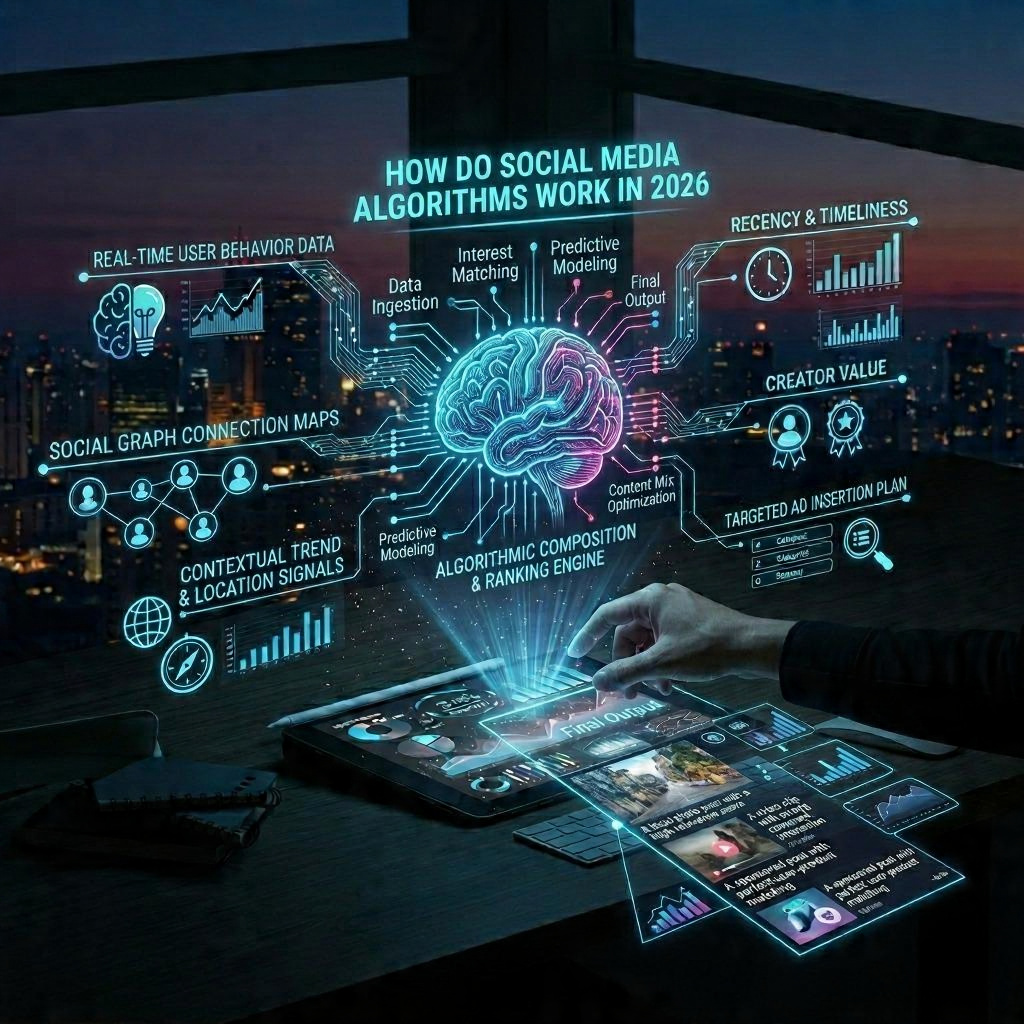
How Do Social Media Algorithms Work in 2026?
If your content is disappearing into the void, you’re not alone — and you’re probably fighting an algorithm you don’t fully understand. Here’s everything you need to know.
Social media in 2026 is not the chronological feed of 2012. Today’s platforms run on deeply sophisticated, AI-driven systems that decide — in milliseconds — whether your post reaches 10 people or 10 million. For brands and creators, understanding these systems isn’t optional. It’s survival.
But here’s the thing: algorithms aren’t the enemy. Once you grasp their strategy, you can move alongside them instead of working at cross-purposes. This guide breaks down exactly how social media algorithms work right now, why AI has changed everything, and what you can do today to make the system work in your favor.
What Is a Social Media Algorithm?
At its core, a social media algorithm is a ranked feed system. Rather than showing users content in the order it was posted, platforms use machine learning models to predict which content a specific user is most likely to engage with — and then surface that content first.
Every time someone opens Instagram, LinkedIn, or YouTube, the algorithm runs thousands of micro-predictions about that person’s preferences. The result is a feed that feels eerily personal, because it essentially.
How AI Powers Modern Social Media Algorithms
From Rule-Based to Neural Network Models
Early algorithms were relatively simple: prioritize posts with more likes, boost content from accounts with more followers. By 2026, that era is long gone. Every major platform now uses deep learning models — the same class of AI behind tools like ChatGPT and image generators — to power content ranking.
These models are trained on billions of data points and update continuously. They don’t just learn what you like; they learn when you like it, how long you linger, and what you do next after consuming a piece of content.
Predictive Engagement Scoring
Every piece of content receives a real-time predictive engagement score before it’s shown to any user. The algorithm asks: given everything we know about this user and this piece of content, what is the probability they will watch it for more than 3 seconds? Like it? Share it? Click the link? Follow the creator?
These probability scores determine distribution. High scores = wide reach. Low scores = near-invisible distribution.
Personalization and User Behavior Signals
The Signals Algorithms Actually Track Algorithms in 2026 track hundreds of behavioral signals. The most heavily weighted include:
- Viewing time and completion performance:- Watching 80% of a video sends a stronger signal than a like.
- Save and share behavior :- saving content signals deep interest; sharing signals high value to the user’s own network.
- Repeated visits :- returning to a profile or replaying content is a very strong positive signal.
- Scroll-past speed — how quickly you scroll past content signals low relevance.
- Comment sentiment:- not just whether you commented, but whether that comment was positive, negative, or a question.
- Interaction history :- your entire history with a creator, topic, or format shapes future distribution.
The Interest Graph vs. the Social Graph
Platforms have largely shifted from social graph prioritization (showing you content from people you follow) to interest graph prioritization (showing you content aligned with your demonstrated interests, regardless of who posted it). a brand-new account with zero followers can reach millions if the content hits the right signals.
The Short-Form Video Effect
Short-form video is no longer a trend :- it’s the dominant content format, and algorithms are built around it. TikTok, Instagram Reels, YouTube Shorts, and LinkedIn Video all prioritize short-form content because it generates more watch sessions, more completion rates, and more overall time-on-platform per user.
Why does this matter algorithmically? Because short-form video generates more data per hour than any other content type. A user can watch 30 Reels in the time it takes to read one article. More data means faster, more accurate personalization — which means platforms can serve increasingly relevant content, which keeps users on the app longer.
For brands, this means short-form video isn’t just “nice to have.” It’s the primary language the algorithm understands.
Platform-Specific Algorithm Strategies
Instagram’s algorithm in 2026 heavily weights Reels, especially those using original audio or trending sounds. It also uses a “trial Reels” feature that tests content with non-followers before distributing to your existing audience. Strong early engagement in the first 30–60 minutes is critical. Carousels remain powerful for reach due to the “re-shown” mechanic — Instagram re-serves carousels to users who didn’t swipe through the first time.
LinkedIn’s algorithm in 2026 strongly favors native video, documents (PDF carousels), and text posts that generate comments within the first hour. It actively deprioritizes external links in posts — put links in the comments instead. It also distributes content based on professional relevance, so niche expertise beats broad entertainment.
YouTube
YouTube remains a hybrid of search and social. Its algorithm weighs click-through rate (CTR) from thumbnails, average view duration, and subscriber satisfaction signals. Long-form and Shorts work together — strong Shorts performance can funnel audiences into a channel’s long-form catalog.
Actionable Tips for Brands
- A focused content strategy in one niche outperforms a scattered broad strategy every time.Getting algorithmic distribution in 2026 requires more than posting consistently. Here’s what actually moves the needle:
- Hook in the first 2 seconds. Every platform measures immediate engagement. If people scroll past your video before the second second, it tanks. Lead with the most compelling part.
- Post natively and stay on-platform. Algorithms penalize content that drives users away. Favor in-app features (Reels, Stories, LinkedIn Docs) over link-heavy posts.
- Optimize for saves and shares, not just likes. These are the highest-value engagement signals in 2026. Create content people want to reference later or send to someone else.
- Batch-test formats. Run A/B tests on thumbnails, hooks, and post timing. Use each platform’s native analytics to identify which formats earn the most reach per post.
- Build niche authority. Algorithms increasingly reward consistent subject-matter expertise.
- Engage in the first hour. Respond to comments quickly after posting. Early conversation signals relevance to the algorithm and boosts initial distribution.
The Human Element Algorithms Can't Replace
As algorithms get smarter, something counterintuitive is happening: the content that breaks through is increasingly human. Authentic storytelling, genuine emotion, real expertise, humor, and vulnerability are performing better than ever — not despite AI, but because of it. When every brand can generate polished content with AI tools, genuine human perspective becomes the differentiator.
This is also why the question of what AI can and can’t do in marketing keeps coming up. If you’re wondering whether AI will completely take over digital strategy — not just algorithms, but the entire marketer role — it’s worth reading our related piece: “Will AI Replace Human Digital Marketers in 2026?” The short answer might surprise you.
Frequently Asked Questions
- Do hashtags still matter in 2026?
Hashtags have significantly decreased in importance across most platforms. Instagram and TikTok now use AI to understand content context without relying on hashtags. They’re still useful as lightweight categorization signals, but using 30 hashtags no longer provides any meaningful reach boost. Use 3–5 highly relevant hashtags at most.
- Does posting frequency affect algorithmic reach?
Yes, but consistency matters more than volume. Posting 4 times per week consistently outperforms posting 15 times one week and nothing the next. Algorithms reward accounts that publish on a predictable cadence because it makes their prediction models more accurate.
- Why does a post sometimes go viral with no followers?
Because most platforms now use interest graph models that can distribute any content to any user, regardless of follow relationships. The algorithm tests content in small batches and expands distribution if early signals are strong. A zero-follower account with excellent content can reach millions.
- Does buying followers or engagement hurt algorithmic reach?
Significantly, yes. Algorithms in 2026 are adept at detecting inauthentic engagement. Fake followers have no behavioral history aligned with your content niche, which creates confusing signals. Most platforms actively suppress accounts that show signs of artificial growth.
Major platforms update their ranking models continuously — often daily for smaller weight adjustments, and several times per year for major structural changes. Following each platform’s official creator blogs and native analytics tools is the best way to stay current.
Conclusion: Work With the Algorithm, Not Against It
Social media algorithms in 2026 are more sophisticated, more personal, and more AI-driven than ever before. But their core logic is simple: they surface content that genuinely serves users. When your content is high-quality, relevant, and designed to earn real engagement, the algorithm becomes your biggest distribution partner.
The brands that win aren’t hacking the system — they’re creating content worth watching, saving, and sharing. They’re consistent, data-informed, and deeply attuned to what their audience actually wants.
Start with one platform. Master its signals. Build from there.
