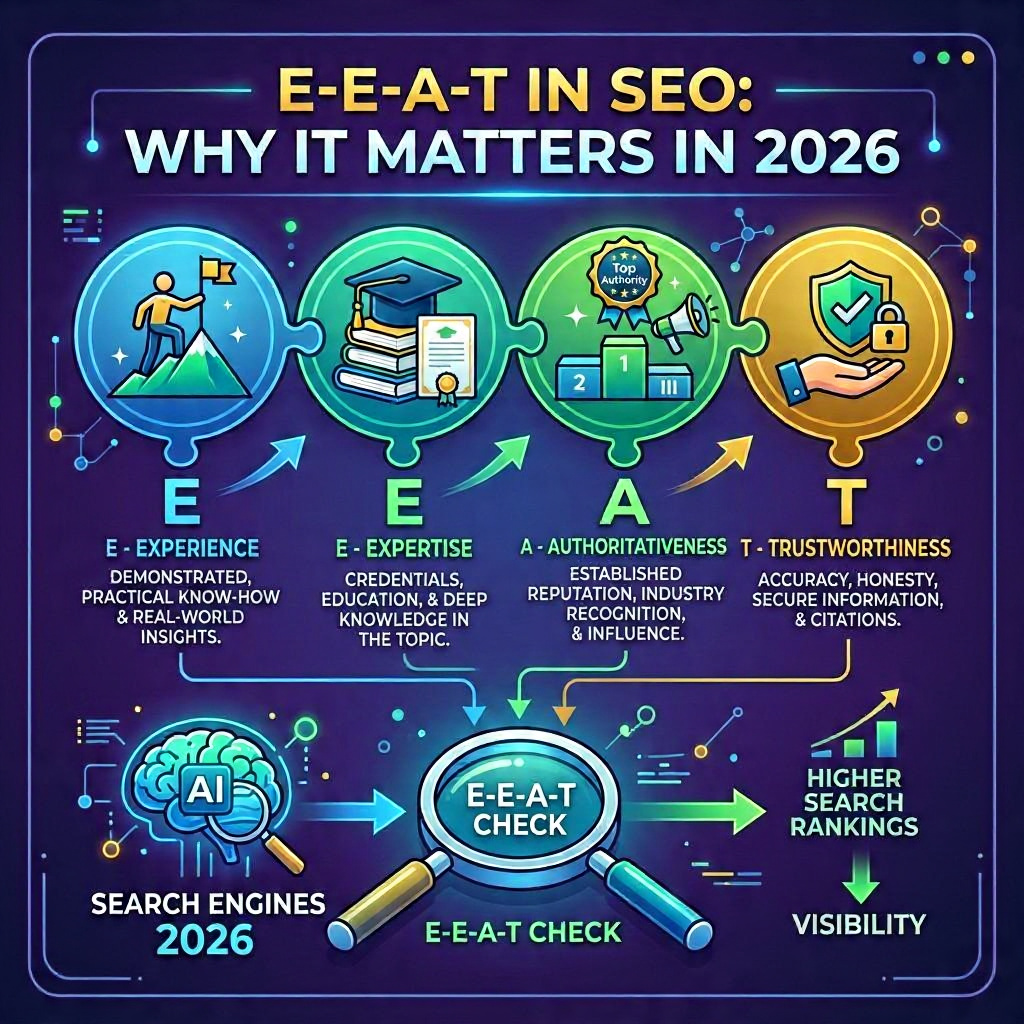
E-E-A-T in SEO: Why It Matters in 2026
A complete guide to Experience, Expertise, Authoritativeness, and Trustworthiness — and how to leverage all four for search dominance.
Introduction: The Search Landscape Has Changed Forever
If you have been doing SEO the same way you did it five years ago, you are already behind. The rise of AI-generated content, Google’s relentless algorithm evolution, and the proliferation of large language model-powered search engines have fundamentally shifted what it takes to rank — and more importantly, what it takes to be trusted online.
Enter E-E-A-T: Experience, Expertise, Authoritativeness, and Trustworthiness. Originally introduced as E-A-T in Google’s Search Quality Evaluator Guidelines, the concept was expanded in late 2022 to include a critical new pillar — Experience. By 2026, E-E-A-T is no longer a soft guideline for quality raters. It is a core framework that shapes how Google, YouTube, and AI-powered search engines assess and rank content.
Whether you are a solo content creator, a brand marketing team, or an enterprise SEO strategist, understanding and implementing E-E-A-T is the most important thing you can do for long-term search visibility. This guide breaks down every dimension of the framework — and gives you the actionable playbook to win.
What Is E-E-A-T? Breaking Down the Framework
E-E-A-T stands for Experience, Expertise, Authoritativeness, and Trustworthiness. These are the four signals Google’s quality raters and algorithms use to evaluate whether a piece of content — and the entity behind it — deserves to rank highly in search results.
Experience
Experience refers to first-hand, lived knowledge of the subject matter. A review written by someone who has actually used the product carries more weight than one that synthesizes secondary sources. Google now actively looks for signals that the author has real-world engagement with the topic.
Expertise
Expertise measures the depth of knowledge demonstrated in the content. This applies to both the individual author and the overall site. YMYL (Your Money or Your Life) topics — health, finance, legal — require demonstrably high expertise. For general topics, a well-structured, well-researched article from a credible source is sufficient.
Authoritativeness
Authoritativeness is about reputation — not just your own, but how others in your industry perceive you. Backlinks from authoritative domains, mentions in industry publications, and citations from credible experts all feed into your authority score.
Trustworthiness
Trust is the cornerstone of E-E-A-T. Google considers trust the most important of the four elements. Factors include HTTPS security, transparent authorship, accurate and updated content, clear editorial policies, and legitimate contact information.
Why E-E-A-T Matters More Than Ever in 2026
The AI Content Flood
AI content generation tools have flooded the web with millions of articles, many of which are technically coherent but experientially hollow. Google’s helpful content systems, now deeply integrated into its core algorithm, are specifically designed to surface content that demonstrates genuine human expertise and experience over mass-produced AI output. E-E-A-T signals are the primary differentiator.
Google's Algorithm Evolution
Google’s 2024 and 2025 core updates dramatically accelerated the enforcement of helpful content principles. Sites that failed to demonstrate clear authorship, topical authority, and consistent quality experienced significant ranking drops. The algorithm now evaluates entity relationships — connecting authors to their credentials, brands to their reputations, and content to real-world outcomes.
AI Search Engines Are Adopting the Same Standards
Platforms like Perplexity, SearchGPT, and Google’s own AI Overviews are trained to source from pages that demonstrate high E-E-A-T. If your content lacks trust signals, it will be excluded from AI-generated answers — cutting off a rapidly growing source of organic visibility.
Platform-Specific E-E-A-T Considerations
Google Search
For traditional Google Search, E-E-A-T is evaluated through a combination of on-page signals and off-page authority. Key considerations include:
- Ientified authors with linked bios and credentials.
- Schema markup for articles, authors, and organizations.
- Consistent publication dates and content update timestamps.
- Citations from peer-reviewed sources, industry bodies, or government sites.
- Strong internal linking that builds topical authority clusters.
YouTube
YouTube’s search algorithm increasingly rewards channels that demonstrate expertise and trustworthiness. This means:
- Consistent upload cadence from a recognizable, credentialed creator
- Video descriptions that link to authoritative sources
- Channel About pages with clear professional background information
- Community engagement and response to comments as experience signals
- Collaboration with recognized experts as authority-building
AI Search Engines
For AI-powered search and answer engines, the priority is structured, citable, and source-transparent content. Brands should:
- Use structured data and FAQ schema to make content easily parsable
- Publish original research, statistics, and data that AI engines can cite
- Maintain a strong Wikipedia presence and Google Knowledge Panel
- Build brand mentions across authoritative media and news platforms
Actionable E-E-A-T Strategies for Brands and Content Creators
1. Credible Author Profiles
Every piece of content should have a named, credentialed author. Create dedicated author pages that link to social profiles, professional certifications, published works, and media appearances. Use schema markup to connect authors to their content systematically.
2. Demonstrate Real Experience
Go beyond theory. Include personal case studies, original data, hands-on product reviews, and real-world outcomes in your content. Use first-person narrative where appropriate. Add photos, screenshots, and videos that prove direct engagement with the subject.
3.Build Topical Authority
Through Content Clusters
Rather than publishing one-off articles, develop comprehensive content hubs around core topics. A pillar page supported by 10 to 20 supporting articles signals deep topical expertise to both users and search engines. Internal linking within these clusters reinforces authority.
4.Earn High-Quality Backlinks
and Brand Mentions
Authority is built externally. Invest in digital PR to earn features in industry publications. Publish guest posts on authoritative sites. Create linkable assets — original research, comprehensive guides, free tools — that naturally attract citations.
5.Establish Trust Through Transparency
Publish a clear editorial policy. Disclose sponsorships and affiliations. Keep all factual content up to date and add review dates to evergreen articles. Ensure your website has HTTPS, a functional privacy policy, and accessible contact information.
6. Enhance Visibility Through Schema & Technical SEO
Implement Article, Person, Organization, FAQPage, and BreadcrumbList schema across your site. These help search engines and AI systems understand who you are, what you cover, and why you can be trusted — even before a human quality rater reviews your site.
7.Monitor Performance and Iterate
Use Google Search Console to track click-through rates and impressions by page. Monitor ranking volatility following core updates. Conduct regular content audits to identify pages that lack E-E-A-T signals and refresh them with updated data, authorship, and citations.
Frequently Asked Questions About E-E-A-T
Q1: Is E-E-A-T a direct Google ranking factor?
Not in the traditional sense. E-E-A-T is not a single algorithmic signal with a numeric score. Instead, it describes the collection of quality signals that Google’s systems use to evaluate content. Think of it as the lens through which Google interprets your site’s overall quality — it influences rankings indirectly through many measurable factors like backlinks, authorship, and user engagement.
Q2: Does E-E-A-T matter for non-YMYL topics?
Yes, though the bar is somewhat lower for topics that do not affect health, finances, or safety. Even for entertainment, lifestyle, or hobby content, demonstrating personal experience and consistent expertise gives you a significant competitive edge — especially as AI-generated content continues to dilute search results in these categories.
Q3: How can small brands compete
with large authority sites?
Small brands can win by going narrow and deep. Rather than trying to compete across broad topics, build unrivaled authority in a specific niche. Publish original research, interview recognized experts, and establish genuine community engagement. Hyper-specificity and authentic experience often outperform general content from large sites.
Q4: How long does it take to
see results from E-E-A-T improvements?
E-E-A-T improvements are a long-term investment. On-page changes — like adding author bios and schema markup — can be indexed relatively quickly. However, building topical authority and earning external brand signals typically takes three to six months before you see meaningful ranking impact. Core algorithm updates, which Google releases several times a year, are often when the largest gains or losses appear.
Q5: How does E-E-A-T apply to AI-generated content?
AI-generated content is not inherently penalized by Google — what matters is whether the content is helpful, accurate, and demonstrates clear expertise. If AI content is reviewed, fact-checked, and enriched by a credentialed human author, it can perform well. Blindly publishing raw AI output without human oversight, however, typically fails E-E-A-T standards, especially for YMYL topics.
Conclusion: E-E-A-T Is Your Long-Term Competitive Advantage
In 2026, the brands and creators who win at SEO are not those with the biggest content budgets or the cleverest keyword strategies. They are the ones who have invested in building genuine trust, demonstrable expertise, and authentic experience — online and off.
E-E-A-T is not a checklist to complete and forget. It is an ongoing commitment to quality that compounds over time. Every expert interview you publish, every data study you release, every author bio you build, and every trust signal you add makes your digital presence more resilient to algorithm changes and AI disruption.
The search landscape will continue to evolve — but the entities that are trusted will always have a place at the top.